Every time a Jackson Academy athlete pulls on a jersey, laces up a pair of cleats, or steps onto a field of competition, they carry a name with them: Raiders. It is a name that has defined this school’s athletic identity for more than five decades, but for many students, the story behind it has remained largely unknown. Chuck Box, in his first year as head baseball coach at Jackson Academy, intends to change that.
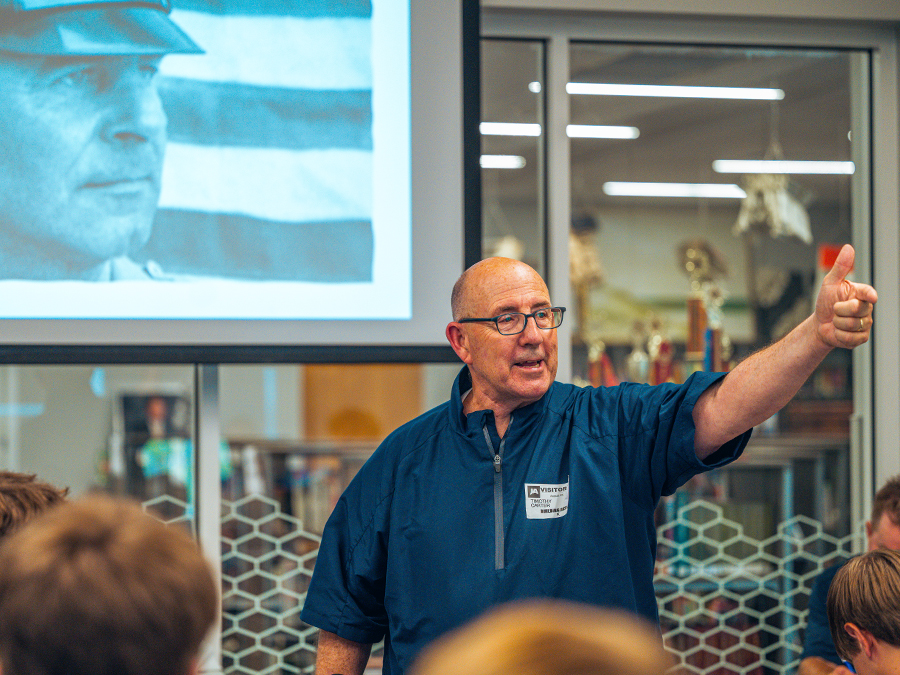
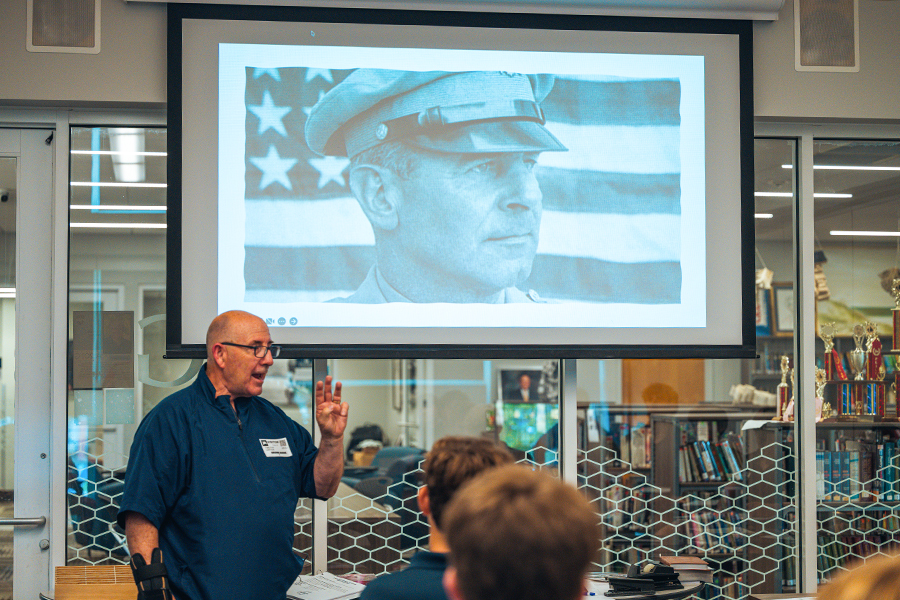
Box has made character development a cornerstone of his program from day one, and this fall he has been bringing in speakers to help his players understand not just how to play the game, but for whom they are playing. The first of those speakers was someone Box knows well. Tim Carter, Box’s high school football coach at Caldwell High School in Columbus, Mississippi, before it consolidated into Columbus High, came to speak to the baseball team about something he knows deeply. Carter, who also served as a paratrooper in the military, spent years learning about the Doolittle Raid, and the story he told connected to Jackson Academy in a way that left an impression on everyone in the room.

“I’ve always believed it’s important for our players to understand who we are playing for,” Box said. “We’re playing for the name on the front. Raiders.”
The name RAIDERS debuted in 1971, born out of a student body contest to choose a mascot for the new junior high football program. Modeled after Gen. Jimmy Doolittle, Raiderman embodies the courage and commitment of the airmen who carried out one of the most daring military operations in American history. This origin story lives in the athletic department’s logo lockup, sent out on graphics and marketing materials, serving as a quiet but constant reminder to all who encounter Jackson Academy athletics of exactly who the Raiders are and where that name originated.
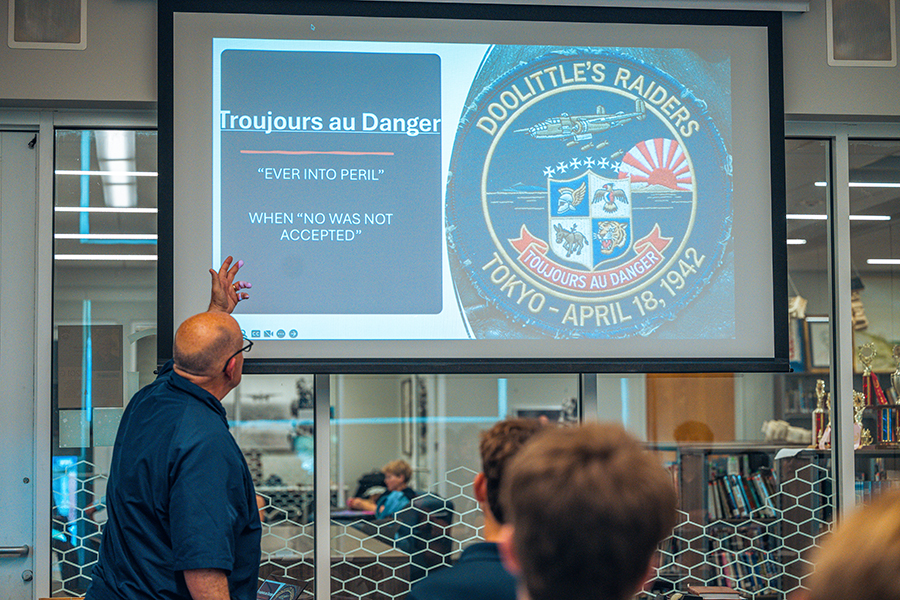
On April 18, 1942, just months after Japan’s devastating attack on Pearl Harbor, Lt. Col. James “Jimmy” Doolittle led 80 volunteer airmen on the first American air strike to hit the Japanese mainland during World War II. Flying 16 twin-engine B-25 Mitchell bombers, the crews faced a problem that had never been solved before. The B-25 was a land-based aircraft, never designed to take off from the deck of an aircraft carrier. The standard airfield takeoff required 1,500 feet of runway. The USS Hornet, the Navy carrier from which the raiders would launch, could offer only 467.
Carter returned to that number throughout his talk with the JA baseball team. Four hundred and sixty-seven feet. The airmen could not change the deck. They could not change the mission. They had to change themselves, stripping weight from the aircraft, removing nonessential equipment, and trusting the preparation they had done to carry them off a deck inadequate for this launch. Carter challenged the team to apply that same mindset to their own season. Be 467 ready. Do what is necessary to complete the mission, even when the conditions are not ideal.

The raid itself targeted Tokyo, Yokohama, Yokosuka, Nagoya, and Kobe, dropping high-explosive and incendiary bombs on military and industrial targets. Japanese opposition during the raid was weaker than expected, but the bombers faced a problem on the back end that was just as dangerous as the enemy. They did not have enough fuel to return to the carrier. Most crews crashed or ditched in occupied regions of China after running out of gas. Eight airmen were captured by Japanese forces. Three were executed following a military tribunal. Others endured years of brutal imprisonment before being rescued.
The physical damage from the raid was limited, but its strategic impact was enormous. The raid shocked Japanese military leadership, forced the redeployment of troops to defend the home islands, and contributed to a series of miscalculations that led directly to Japan’s catastrophic defeat at the Battle of Midway less than two months later. Doolittle himself received the Medal of Honor and went on to command air forces in both the European and North African theaters.

It is a story of courage, sacrifice, and the willingness to attempt what seems impossible because the mission demands it. It is, in short, the story behind the name every Jackson Academy athlete wears.
Box has built his program around that understanding. Baseball games are won and lost on the field, but the lessons that stick, the ones that shape who a player becomes long after his playing days are over, are learned in moments like the one Tim Carter created in that room. Be 467 ready. Know the name on your jersey. Play for something bigger than yourself.
That is what it means to be a Raider.